From Salt to Gold: The Spontaneous Origin of Money
By José E. Pérez – for Althaia | News Post – Your Finance Data Source
Money as a Market Institution
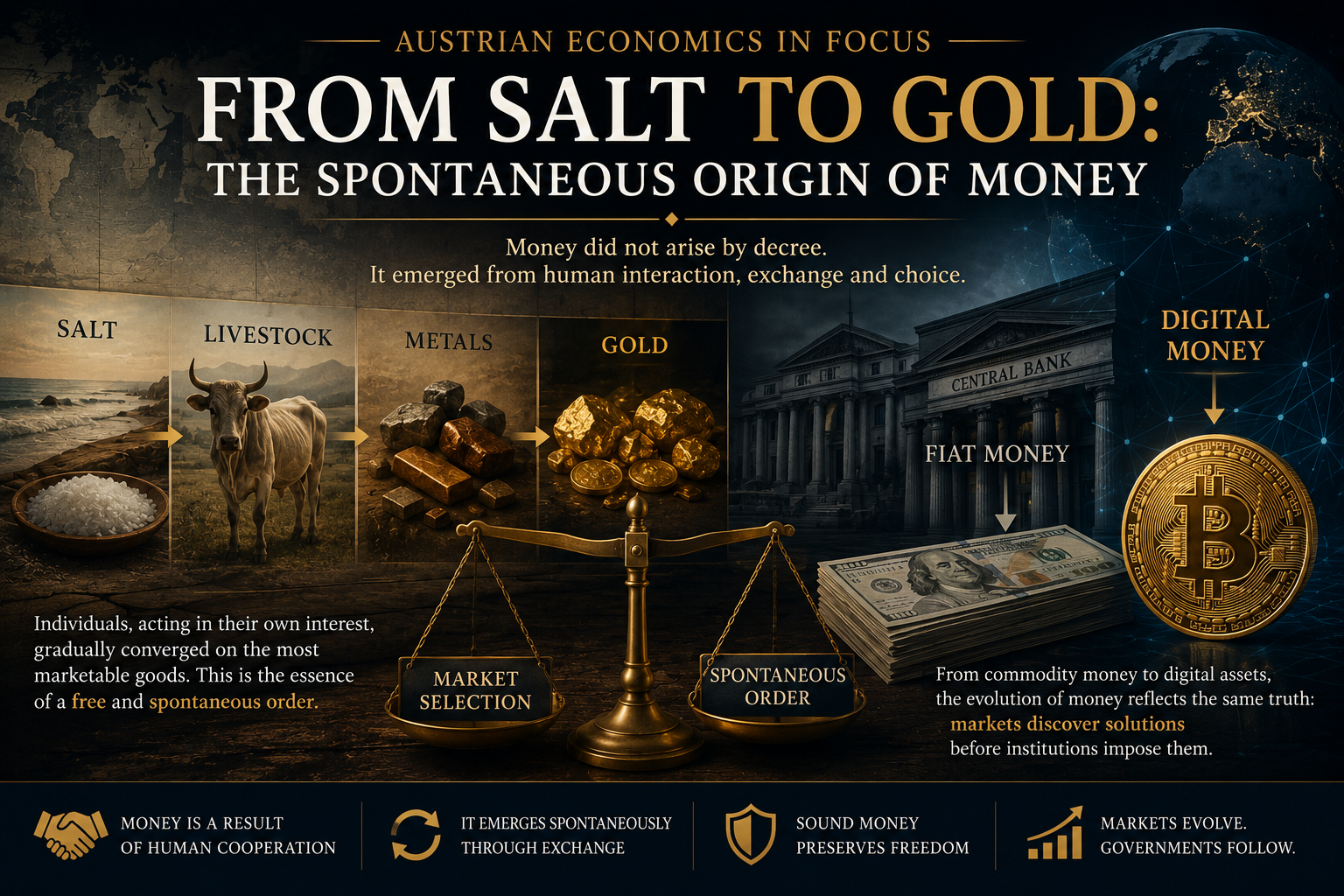
Money did not emerge by decree, nor as the result of a centralized plan. It arose spontaneously from the interactions of individuals seeking to facilitate exchange.
Carl Menger, founder of the Austrian School, demonstrated that money is the natural outcome of a market process in which certain goods become widely accepted due to their superior saleability.
In early economies, barter created significant inefficiencies. Individuals were forced to find a “double coincidence of wants,” limiting the scope of trade.
From Commodities to Medium of Exchange
Over time, certain goods began to be used not for direct consumption, but for their ability to be exchanged more easily. Among them:
- Salt
- Livestock
- Precious metals
These goods shared key characteristics:
- Durability
- Divisibility
- Portability
- Recognizability
Gold, in particular, emerged as the most efficient medium of exchange due to its scarcity, resistance to decay, and universal acceptance.
The Role of Market Selection
The transition from barter to money was not imposed—it was selected.
Individuals, acting in their own interest, gradually converged on the use of the most marketable goods. This process reflects a broader principle of the Austrian School:
Social institutions often emerge as unintended consequences of individual actions.
Money, therefore, is not a political construct but a social evolution.
From Commodity Money to Fiat Systems
Modern monetary systems have largely abandoned commodity money in favor of fiat currencies issued by central banks.
While fiat money provides flexibility for monetary policy, it also introduces risks:
- Inflationary pressures
- Loss of purchasing power
- Political manipulation of money supply
This shift represents a departure from the original market-based origin of money.
A Contemporary Perspective
In recent years, the emergence of digital assets—particularly Bitcoin—has revived the debate about the nature of money.
Like early commodity money, Bitcoin was not imposed by authority. Its adoption follows a similar pattern:
- Voluntary acceptance
- Market-driven valuation
- Decentralized structure
This raises a fundamental question:
Can money once again emerge independently of the state?
Conclusion
Money is not an invention of governments but a product of human interaction.
From salt to gold—and now potentially to digital assets—the evolution of money reflects the same underlying principle:
Markets discover solutions before institutions attempt to regulate them.
References
- Menger, C. (1871). Principles of Economics.
- Menger, C. (1892). On the Origin of Money.
- Pérez, J. E. (2024). Final Examination – Austrian Economics Program (UCEMA).
Institutional Credit and Certification
This article is part of the final work presented within the framework of the
Austrian Economics Program – Universidad del CEMA (UCEMA),
directed by Dr. Adrián Ravier (Academic Director, PhD in Economics, UFM)
with the participation of Dr. Alberto Benegas Lynch (PhD in Economics, University of Chicago),
with José E. Pérez as graduate student and author of this work.