Subjective Rationality: Human Action According to Mises
By José E. Pérez (UCEMA) – for Althaia | News Post
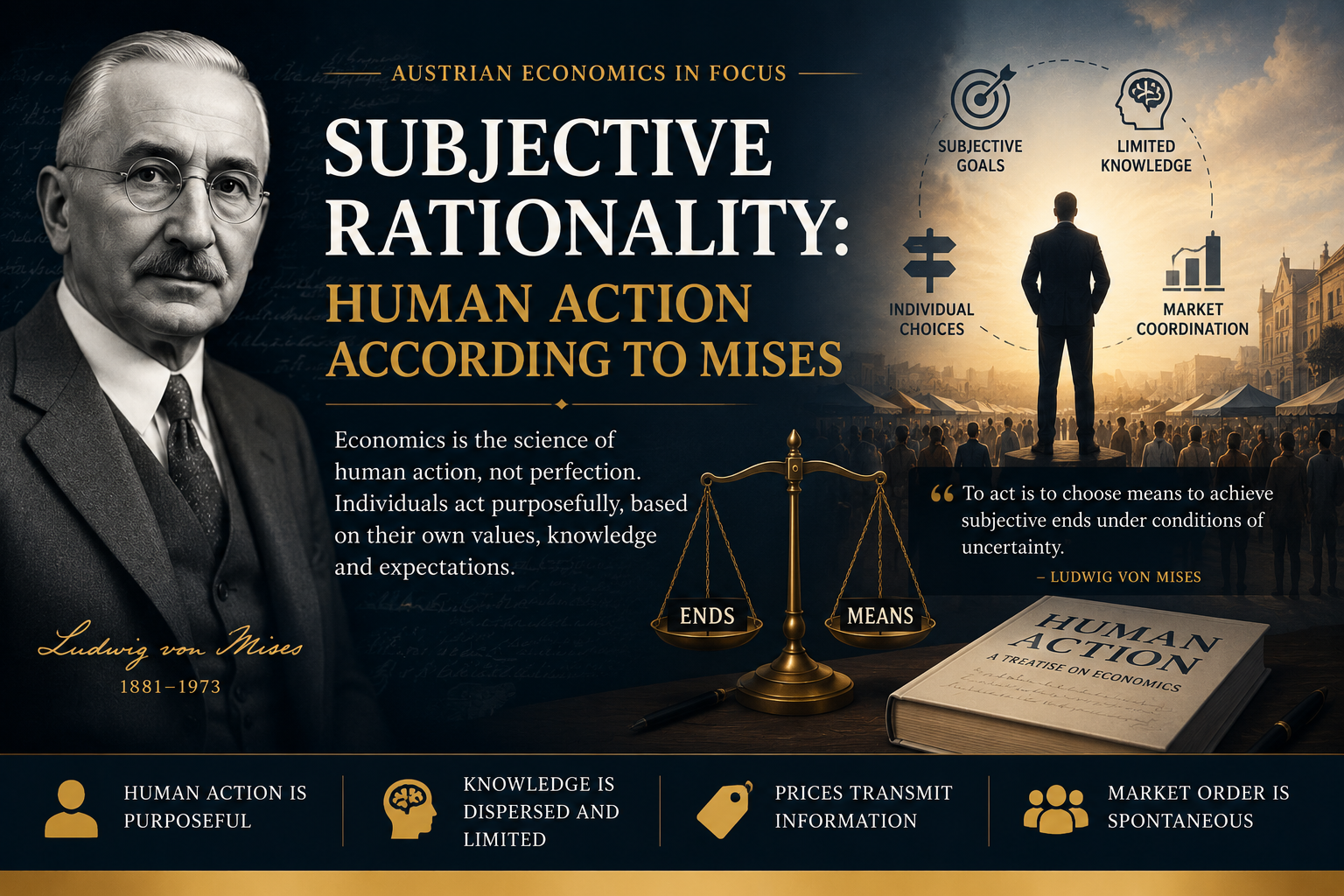
Economics as a science of action, not perfection. Ludwig von Mises redefined rationality from the perspective of individual freedom and human diversity.
Ludwig von Mises broke with the dominant paradigm of neoclassical economics by placing the individual—not equations—at the center of economic theory. In his seminal work Human Action (1949), he developed praxeology, understood as the science of purposeful human action.
According to Mises, every action has a subjective purpose: individuals act to move from a less satisfactory state to a more satisfactory one, based on their own values and perceptions. Rationality is not measured by objective outcomes or universal standards of efficiency, but by the coherence between the ends pursued and the means chosen.
This praxeological approach redefines the concept of rationality. While other schools assume an omniscient and calculating agent, the Austrian School recognizes that human knowledge is limited and dispersed. People make decisions under uncertainty, yet still achieve coordination through the price system.
Mises’ theory restores humanity to economics: there are no perfect agents, only individuals with value judgments, preferences, and changing expectations. Even error and uncertainty are essential components of the economic process.
His thinking anticipated modern debates in behavioral economics and decision theory. Today, in an era of algorithmic models that attempt to replace human deliberation, his warning remains relevant: human action cannot be reduced to mechanical calculation.
Conclusion: Economic rationality is not a mathematical formula, but a manifestation of free will. To act is to choose—and to choose is to be free.
References
- Mises, L. von. (1949). Human Action: A Treatise on Economics.
- Pérez, J. E. (2024). Final Examination – Austrian Economics Program (UCEMA).
Institutional Credit and Certification
This article is part of the final work presented within the framework of the
Austrian Economics Program – Universidad del CEMA (UCEMA),
directed by Dr. Adrián Ravier (Academic Director, PhD in Economics, UFM)
with the participation of Dr. Alberto Benegas Lynch (PhD in Economics, University of Chicago),
with José E. Pérez as graduate student and author of this work.