Mises and the Minimal State: Between Order and Liberty
By José E. Pérez for Althaia | News Post – Your Finance Data Source
The State as a Means, Not an End
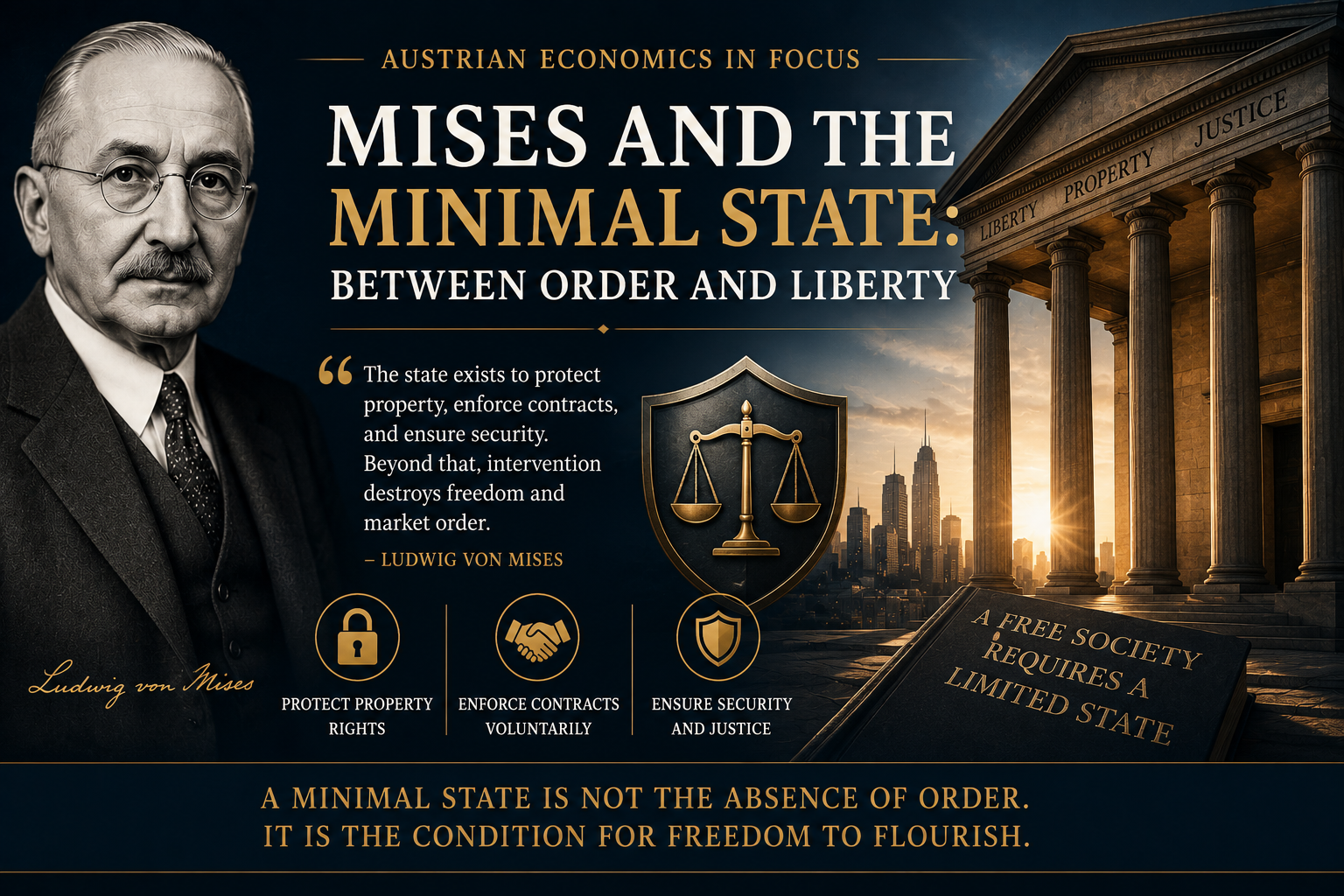
Ludwig von Mises developed a clear and rigorous defense of the minimal state as a necessary institution to preserve social order and individual liberty. Unlike anarchist approaches, Mises did not reject the existence of the state; rather, he defined its role with strict limits.
For Mises, the state exists to protect three fundamental pillars of a free society:
property rights, contractual enforcement, and security.
Beyond these essential functions, state intervention distorts the natural coordination of the market.
The Problem of Interventionism
Mises argued that interventionism is inherently unstable. Government interference in markets—through price controls, subsidies, or regulations—creates unintended consequences that often require further interventions.
This process generates a cumulative dynamic:
One intervention leads to another, progressively eroding economic freedom.
What begins as a corrective measure can evolve into systemic control, undermining the efficiency and adaptability of decentralized decision-making.
Market Order vs. Political Allocation
In a free market, resources are allocated through voluntary exchanges based on individual preferences. Prices emerge as signals that reflect scarcity and guide production decisions.
In contrast, political allocation replaces this decentralized mechanism with centralized decisions, often influenced by short-term interests rather than long-term efficiency.
Mises emphasized that:
- Markets coordinate through voluntary cooperation
- States tend to operate through coercive mechanisms
This distinction is critical in understanding the limits of public intervention.
Freedom as a Precondition for Prosperity
Economic freedom is not merely a moral principle—it is also a functional requirement for prosperity. When individuals are free to act, innovate, and exchange, the system evolves dynamically, adapting to changing conditions.
The minimal state ensures that this process remains intact without imposing artificial constraints.
Conclusion
The role of the state, according to Mises, is not to direct the economy but to protect the institutional framework that makes economic coordination possible.
A minimal state is not the absence of order—it is the condition for spontaneous order to emerge.
References
- Mises, L. von. (1949). Human Action: A Treatise on Economics.
- Mises, L. von. (1927). Liberalism: The Classical Tradition.
- Pérez, J. E. (2024). Final Examination – Austrian Economics Program (UCEMA).
Institutional Credit and Certification
This article is part of the final work presented within the framework of the
Austrian Economics Program – Universidad del CEMA (UCEMA),
directed by Dr. Adrián Ravier (Academic Director, PhD in Economics, UFM)
with the participation of Dr. Alberto Benegas Lynch (PhD in Economics, University of Chicago),
with José E. Pérez as graduate student and author of this work.