Savings as the Engine of Progress
By José E. Pérez – for Althaia | News Post – Your Finance Data Source
The Foundation of Economic Growth
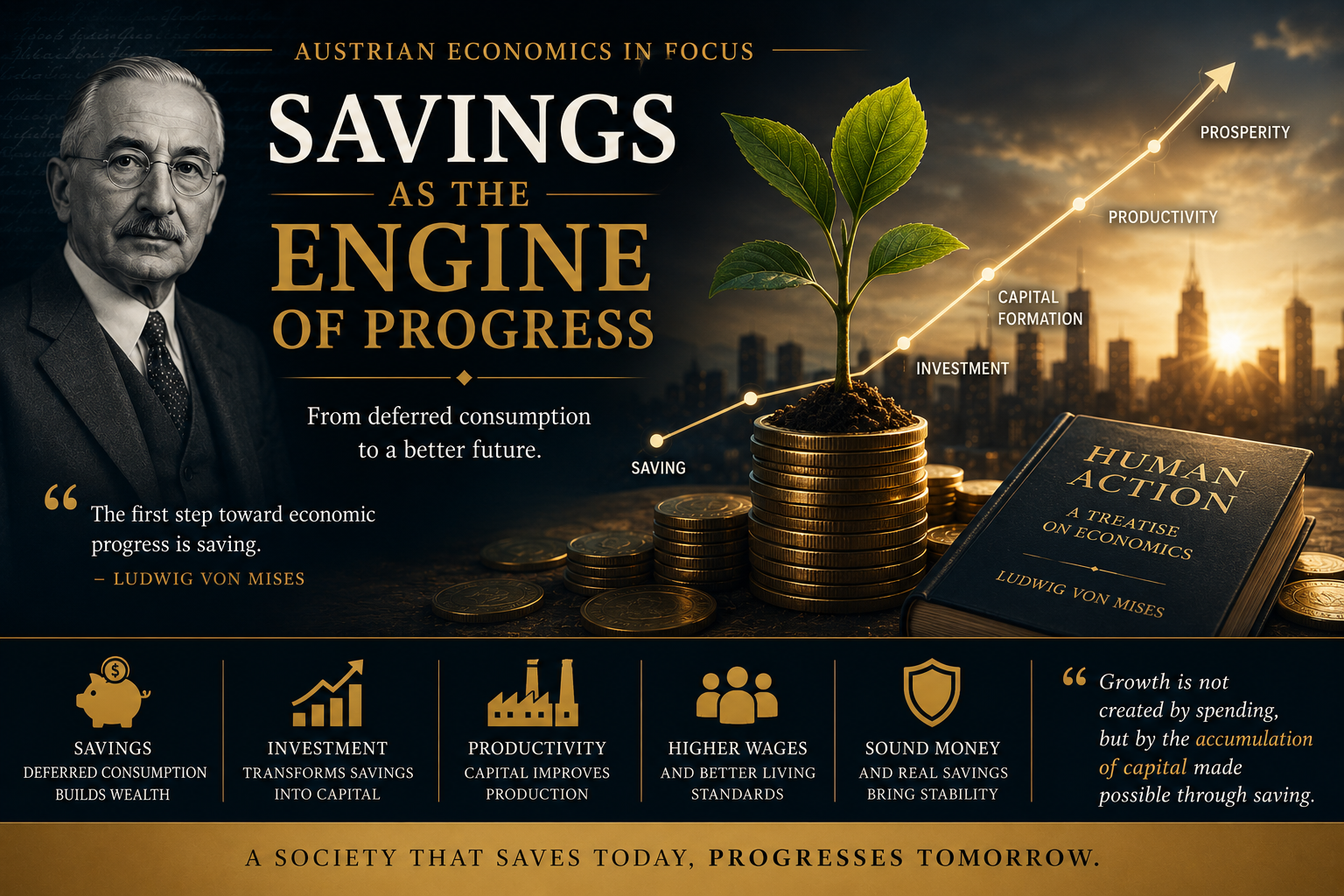
Economic progress does not begin with consumption—it begins with saving.
Within the Austrian School, savings are understood as the essential condition that allows capital accumulation, investment, and long-term productivity growth. Without prior saving, there can be no sustainable expansion of the economic system.
Saving represents deferred consumption: individuals choose to postpone present satisfaction in order to enable greater future possibilities.
Capital Formation and Time Preference
At the core of this process lies the concept of time preference.
Individuals value present goods more than future goods, but when they decide to save, they reduce their time preference and make resources available for investment.
This allows:
- The expansion of capital goods
- Technological development
- More complex and productive economic structures
Savings, therefore, are not idle resources—they are the fuel of economic transformation.
Investment and Productivity
When savings are channeled into investment, they finance entrepreneurial activity and innovation.
Entrepreneurs use these resources to:
- Develop new technologies
- Improve production processes
- Expand supply
This leads to increased productivity, which ultimately translates into higher real wages and improved living standards.
In this framework, consumption is not the driver of growth—it is the result of prior saving and investment.
The Distortion of Artificial Expansion
Modern economic policies often attempt to stimulate growth through artificial means, particularly via credit expansion and monetary intervention.
However, when investment is not backed by real savings, the result is:
- Malinvestment
- Economic cycles
- Financial instability
Artificially low interest rates send misleading signals to investors, distorting the structure of production.
Savings, Stability, and Freedom
A society that values saving builds a more stable and resilient economic system.
Savings:
- Reduce dependence on external financing
- Provide a buffer against uncertainty
- Strengthen long-term growth
From the Austrian perspective, sustainable development cannot be engineered through policy—it must emerge from individual decisions aligned with real resource availability.
Conclusion
Savings are not a passive act—they are the starting point of all genuine economic progress.
Growth is not created by spending, but by the accumulation of capital made possible through saving.
A prosperous economy is one that respects this fundamental principle.
References
- Mises, L. von. (1949). Human Action: A Treatise on Economics.
- Böhm-Bawerk, E. von. (1889). Capital and Interest.
- Pérez, J. E. (2024). Final Examination – Austrian Economics Program (UCEMA).
Institutional Credit and Certification
This article is part of the final work presented within the framework of the
Austrian Economics Program – Universidad del CEMA (UCEMA),
directed by Dr. Adrián Ravier (Academic Director, PhD in Economics, UFM)
with the participation of Dr. Alberto Benegas Lynch (PhD in Economics, University of Chicago),
with José E. Pérez as graduate student and author of this work.